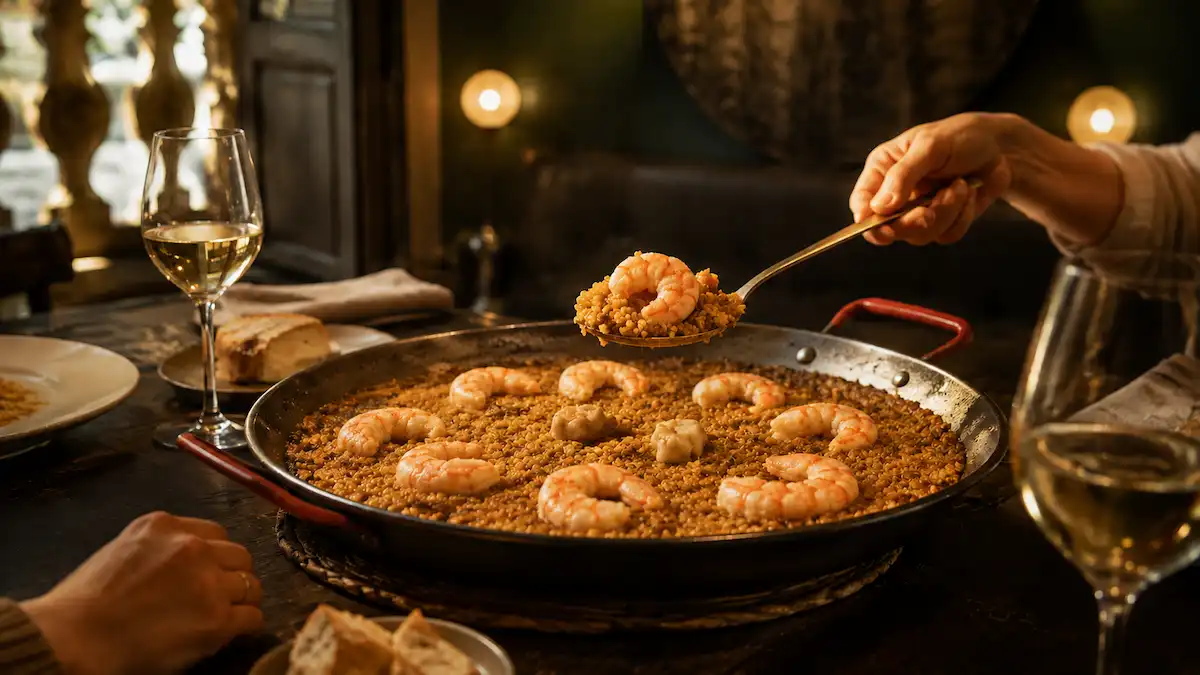
Arroz del senyoret: what is in it and why you can eat it without getting your hands dirty
Did you know there is a rice dish created, essentially, so you never have to get your fingers messy? Arroz del senyoret is exactly that: seafood rice with everything that gets in the way removed before it reaches the table. No shells, no heads, no bones. Just the rice, the taste of the sea and your fork.
I am Víctor Hugo, an agricultural engineer and chef at Fum de Llum. I spend my days between the fields around La Albufera and the flames of a rice restaurant in Valencia, and take it from us: few rice dishes are as misunderstood as this one. Some people think it is a paella. Others confuse it with arroz a banda. And some assume that, because the seafood is peeled, it is simply a dish for people who want an easy meal.
Let us take it one step at a time.
What is arroz del senyoret?
Arroz del senyoret is a dry seafood rice dish in which every ingredient is served cleaned and peeled. The prawns have no shells. The squid comes in ready-to-eat pieces. The fish has no bones. You sit down, pick up your fork and have nothing else to do.
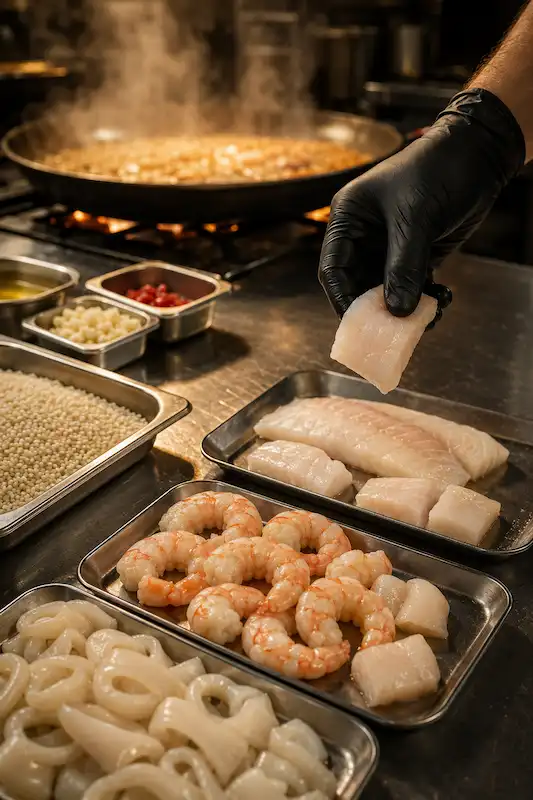
You may see it written in several ways —arroz senyoret, arroz al senyoret or, in Valencian, arròs del senyoret— but they all refer to the same dish.
That sounds like convenience. And it is, but that is not the main point. The seafood is peeled before cooking, not merely before serving. The heads and shells are not thrown away: they go into the stock. All the flavour that, in other rice dishes, stays inside the shell and ends up on the tablecloth is extracted first and absorbed by the rice.
It is a cooking decision, not a matter of etiquette. The result is a rice dish with a deeper taste of the sea.
Why is it called “del senyoret”?
Senyoret is Valencian for “young gentleman”. According to a story repeated in rice restaurants all along the coast —oral tradition rather than a documented fact— the name began as a little joke. The senyoret was someone who sat down to eat without wanting to dirty his hands or his shirt. So the rice arrived ready to eat: not a single prawn to peel.
What began as a joke became a technique. A demanding one, too: when there is nothing to peel, there is nothing to hide behind.
Is arroz del senyoret a paella?
This is where precision matters, because the confusion is widespread: many people search for “paella del senyoret” or “paella senyoret”.
The short answer: it is not a paella, although it is cooked in a paella pan.
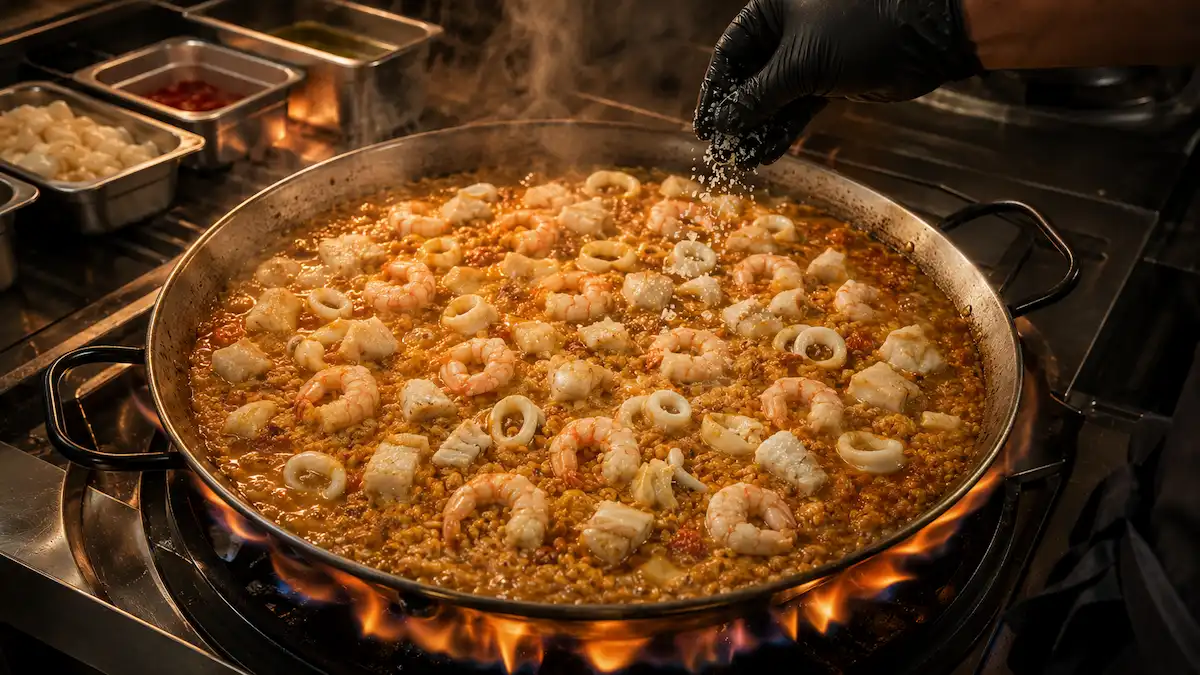
Originally, paella means the pan: wide, shallow and fitted with two handles. In Valencia, “paella valenciana” also refers to a specific, fairly well-defined recipe with chicken, rabbit, garrofó —a large, flat white bean from the Valencian countryside— and bajoqueta, a local green bean. If you want to know what goes into an authentic Valencian paella, we cover it in detail in another article. It deserves one of its own.
Senyoret is made in the same pan using the same dry-rice technique, but it is a different recipe from a different family: seafood rice dishes. Calling it “paella del senyoret” is hardly a crime; it is simply imprecise. We serve it under its own name, as a rice dish, just as we do with the rest of the rice dishes and paellas we make in Valencia: each one has its own name.
What goes into arroz del senyoret?
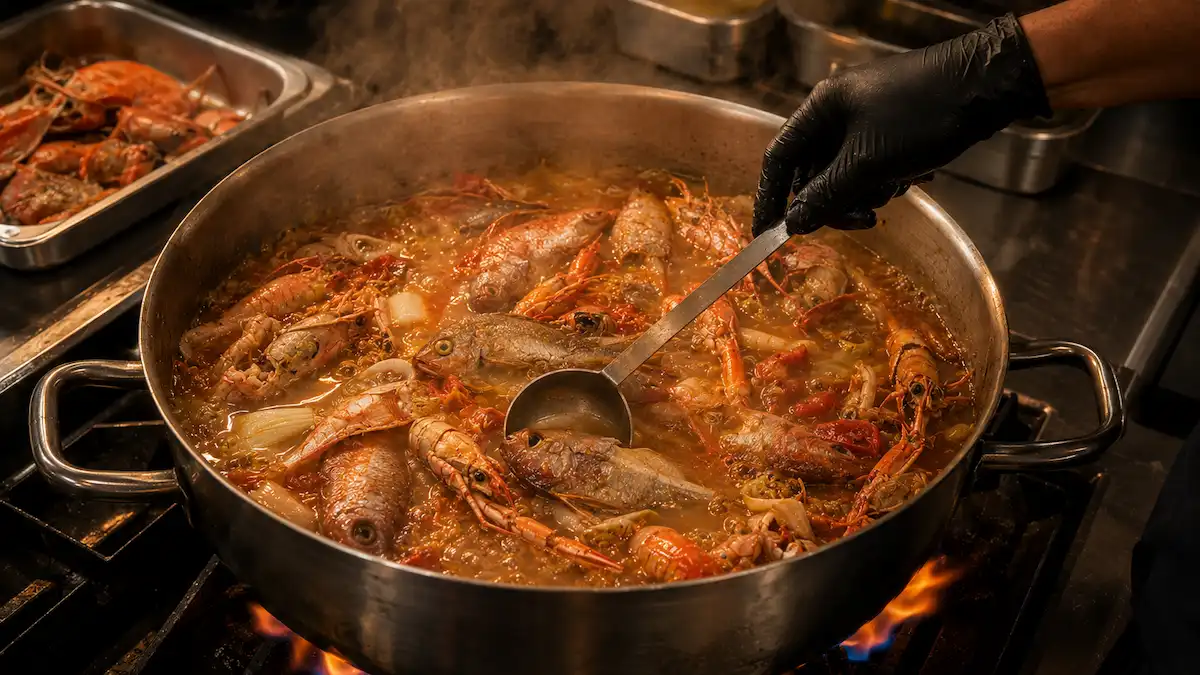
Fewer ingredients than most people imagine, and every one of them has to be right.
The fumet: where the real work happens
Arroz del senyoret is, above all, about the stock. The fumet —a concentrated stock made from rockfish and the heads and shells of the seafood— provides almost all the flavour, because there is not a single prawn head left to draw flavour from at the table.
That is what makes this dish unforgiving. With whole seafood, you taste some of the flavour as you bite into it. Here you do not: if the fumet is weak, the dish is weak, and there is nowhere to disguise it. That is why we say senyoret is the rice dish that reveals a kitchen’s skill fastest.
The rice: the variety is anything but a detail
Rice that must absorb such a rich stock needs a grain that holds its shape. We work with varieties covered by the Arroz de Valencia Protected Designation of Origin, the certification that the rice was grown in the fields of La Albufera and the surrounding area.
It is more than an attractive label: the rice variety you choose changes how much stock the grain absorbs, how long it takes to cook and how forgiving it is if you leave it a minute too long. We explore that subject in a separate article.
The sofrito and the colour
A sofrito of garlic, tomato and ñora —a small, dried, sweet red pepper that adds colour and depth without heat—. A little saffron. And not much else. Good arroz del senyoret needs no decoration: it needs carefully made stock and control of the heat.
What is the difference between arroz a banda and arroz del senyoret?
It is the question we hear most often, and understandably so: the two dishes are close relatives.
The dish called arroz a banda literally means “rice on the side”. It originated on fishing boats: the fish was cooked separately, and the rice was then made with its stock. They were served in two stages, a banda, each part on its own. In the classic version, the rice arrives at the table almost on its own, with no pieces of seafood, but all the flavour in the grain.
Senyoret starts from the same idea —making the most of seafood stock— and takes it one step further: instead of serving the fish separately, it adds cleaned seafood to the rice. Arroz a banda separates; senyoret brings everything together, already peeled.
In one sentence: arroz a banda has no seafood in the rice on your plate; senyoret does, but you never have to handle it.
Is it a dish from Alicante or Valencia?
In all honesty, the best-documented senyoret tradition is linked to the Alicante coast, where it is often made with salmorreta, a paste of ñora, garlic and tomato that is a hallmark of the local cuisine.
And here is something you may not expect a Valencian rice restaurant to say: we see no need to argue over it. Rice cooking forms a continuum from La Albufera to the Marina Alta, regardless of administrative borders. Senyoret belongs to this region in the broadest sense.
What we do is cook it from our own place in that tradition, with our fumet, our rice and our way of judging the cooking point. That does not make it more authentic than the Alicante version: it makes it ours.
How to recognise a good arroz del senyoret
If you are going to order it, look for these four things. They will help you anywhere, whether you eat here or somewhere else.
- The grains: separate and intact. Each grain should stand apart from the next, neither sticky nor undercooked in the centre. Dry rice that clumps together has usually had too much stock or too little heat.
- The colour: from the stock, not colouring. The colour should come from the fumet, ñora and saffron. A bright, uniform orange often means food colouring has done the work the stock should have done.
- The base of the pan. Lift a little rice with the tip of your fork and look for the socarrat: the thin, toasted, crisp layer that forms at the bottom of the paella pan when the rice finishes well. It is not burnt rice. It is caramelised rice, and the sign that someone paid attention to the heat in the final minute.
- The wait. Rice served in ten minutes was not cooked for you. Good rice takes time, and that is good news.
Where to eat arroz del senyoret in Valencia
If you have read this far, you know what to look for. All that is missing is a table.
At Fum de Llum, senyoret is one of our permanent rice dishes. We make it with our own fumet and rice covered by the Protected Designation of Origin, and we never rush it, because rushed rice is difficult to enjoy. We also believe a dish like this is best shared: it is, by nature, a rice dish for good company, long conversations and time at the table.
Everything you have read about the fumet, the texture of the grain and the socarrat is worth trying at home. It really is. But there is one part that does not travel: arroz del senyoret in Valencia, made with rice from these fields and eaten just a short distance from La Albufera, tastes different.
If you would like to try it, you can book a table at our rice restaurant in Valencia and we can talk about it over the dish itself, where these things make the most sense.
Frequently asked questions about arroz del senyoret
What goes into arroz del senyoret? It contains rice, a concentrated stock of rockfish and seafood, a sofrito of garlic, tomato and ñora, saffron, and cleaned fish and seafood: peeled prawns, pieces of squid and boneless fish. Its defining feature is not one ingredient but the fact that everything arrives ready to eat.
What is the difference between arroz a banda and arroz del senyoret? Arroz a banda arrives almost on its own, with the fish served separately and its flavour absorbed by the rice. Arroz del senyoret includes seafood in the rice, but it is already peeled and cleaned. One separates the fish from the rice; the other brings them together without shells.
Is arroz del senyoret the same as paella del senyoret? They are two names for the same dish. It is cooked in a paella pan, which explains the popular name, but technically it is a dry seafood rice dish rather than paella valenciana, a different recipe with chicken, rabbit and vegetables from the Valencian countryside.
Why is the seafood in arroz del senyoret peeled? Because the heads and shells are used first to make the fumet. The flavour that would otherwise stay in the shells passes into the stock and then into the rice. Not having to peel anything at the table is the result, rather than the sole purpose.
Is arroz del senyoret from Alicante or Valencia? Its best-documented tradition is linked to the Alicante coast, where it often includes salmorreta. It is also cooked throughout the Valencian Community and is a familiar dish in Valencia’s rice restaurants, each with its own fumet and preferred cooking point.
Víctor Hugo · Agricultural engineer and chef at Fum de Llum. He knows rice from both sides: the fields where it grows and the fire where the final result is decided. He writes about rice, seasonal produce and ingredients on the Fum de Llum blog.


FROM THE FUMET TO THE FIRST BITE
Rice makes more sense when it reaches the table
If you would like to discover a seafood rice dish made to be enjoyed without rushing, explore our menu and choose when to visit.
You may also like